
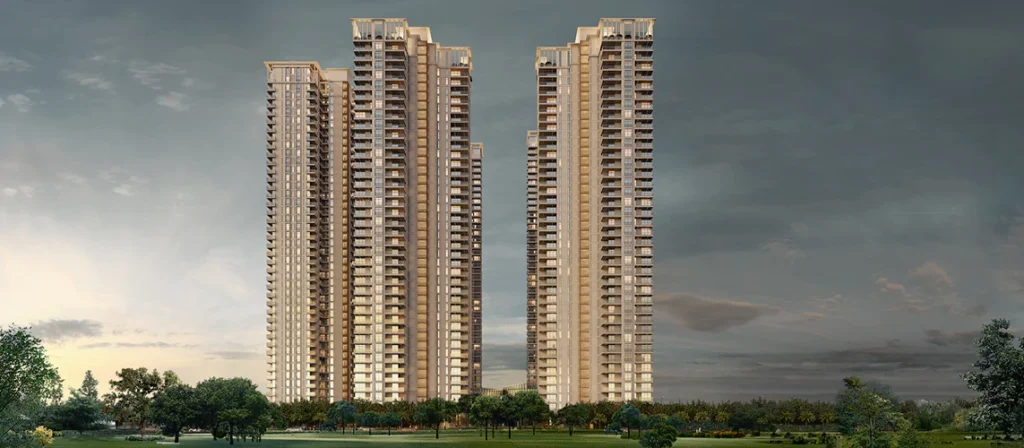
When TARC Ltd. announced in November 2024 that it had sold half of its Tarc Ishva Sector 63A Gurgaon inventory in the opening cycle – roughly ₹1,350 crore of bookings against a 1.35-million-square-foot tower complex in Sector 63A – the listed-equity desk took notice. The stock moved 3% on the day. Eighteen months later, the developer’s H1 FY26 disclosure confirmed that Phase 1 of the project was “nearly sold out,” and that Ishva, alongside TARC Kailasa and TARC Tripundra, was carrying a combined gross development value of roughly ₹7,700 crores for the company.
Strong opening absorption is, in this market, the easy part of the story. The harder question – the one a long-horizon investor in a ₹6-8.5 crore residential ticket actually needs to answer – is whether a sold-out launch on Golf Course Extension Road in 2024-25 translates into a defensible re-rating by the 2031 possession window. There are three pieces to that question, and they do not all point in the same direction.
What the project actually is
The specifics of TARC Ishva Sector 63A Gurgaon are well-documented in HARERA filings and the developer’s investor disclosures, and are worth restating cleanly because most of the analytical work flows from them.
The project sits on a 7-acre parcel in Sector 63A, along Golf Course Extension Road, and is registered under HARERA GGM/865/597/2024/92. It comprises five high-rise towers at G+40 floors, with a total of approximately 386-400 ultra-luxury residences. The configuration mix is unusual: 3 BHK units at around 2,858 sq. ft. and 4 BHK units at around 3,883 sq. ft., with a single apartment per floor in each tower and a private lift lobby, a layout that is closer to a boutique luxury format than a typical Indian high-rise. The architecture brief leans on four-sided open residences, Aravali views, and golden-ratio proportions, which translates more practically into better natural light, ventilation, and resale narrative. Possession is scheduled for December 2031.
Reported pricing varies by source and tower placement, but the cluster sits in the ₹20,700-21,400 per sq. ft. band as of Q1 2025, which produces a 3 BHK starting price of roughly ₹7 crore and a 4 BHK starting price of roughly ₹9.13 crore. By the standards of the corridor in 2025-26, this is mid-band luxury – below the ₹28,000+ per sq. ft. new-launch tier in Sector 63A but well above the ₹15,000–18,000 band that defined the corridor as recently as 2022.
That mid-band positioning matters for the appreciation thesis. It is the level at which the absorption math has tended to work best on Golf Course Extension Road, and it is the level at which TARC’s most recent comparable, Kailasa, sold out Phase 1 within three months of launch.
The corridor argument
Any thesis on Ishva’s long-term appreciation has to begin with the corridor, not the project. Golf Course Extension Road has, on the published numbers, repriced sharply over the past 24 months. Average residential rates moved from roughly ₹24,855 per sq. ft. in 2024 to about ₹37,899 per sq. ft. in 2025, according to corridor tracking from major brokerages. Sector 63A specifically averaged about ₹22,500 per sq. ft. in early 2026 – still a 35-40% discount to the parent Golf Course Road at ₹27,200 per sq. ft., but on land that sits within the same effective commute radius to Cyber Hub and Udyog Vihar.
The structural drivers behind the repricing are reasonably durable. The road itself was widened to a 16-lane signal-free spine; the commercial cluster around Sectors 65-67 (Two Horizon Centre, M3M IFC, Paras Square) pulled in Google, IBM, EY, and KPMG as occupiers; and Golf Course Road proper effectively ran out of new-build land, with the established stock – DLF Camellias, the Magnolias – trading at ₹75,000-₹80,000 per sq. ft. on resale. Buyers who would once have written cheques on the parent corridor have been migrating two kilometres south.
Anarock’s 2025 annual review reported that homes priced above ₹2.5 crore accounted for more than 21% of new national supply, and that Delhi-NCR held its share of the country’s luxury housing sales at close to 90% even after an 8% YoY volume decline. Knight Frank India’s Residential Market 2025 report found that homes above ₹1 crore now account for 50% of all sales across the top eight Indian cities – a 14% YoY rise – while the sub-₹50 lakh segment fell 17%. The money is moving upward, and Gurgaon’s Golf Course Extension corridor is one of the postal addresses absorbing it.
For an Ishva buyer, the corridor signal is the strongest part of the thesis. The corridor has priced in convergence with the parent Golf Course Road; whether it can continue to do so at 10–15% annually through 2026-27, which is the consensus forecast in the Anarock and Oak N Stone notes, is what the appreciation case rests on.
The product argument
Within the corridor, Ishva’s product specification is where the project does most of its differentiation work. Single-unit floor plates, private lift lobbies, four-side open residences, and 2,858-3,883 sq. ft. footprints are not standard mid-band specs in Gurgaon’s luxury supply – they are upper-band specs being delivered at mid-band pricing. The competitive set in Sector 63A, including Sobha Crescent and Conscient Elevate, has either gone heavier on tower density (more units per floor) or higher on entry price (₹28,000+ per sq. ft.). Ishva sits between the two.
That positioning produces a specific resale narrative. Single-key-per-floor luxury in Indian metros has historically held its price better through cycles than four-units-per-floor product, partly because the supply is structurally smaller and partly because the buyer profile (CXOs, NRIs, single-family buyers upgrading from older Gurgaon stock) is less price-sensitive on a possession-stage exit. If the product holds the spec promised in the brochure through actual delivery, the 2031 buyer is purchasing a relatively rare format in the corridor.
The developer balance sheet – where the thesis gets harder
This is the part of the analysis that the marketing brochure will not run through, and it is the part that matters most for a 2031 possession.
TARC Ltd., the listed entity formerly known as Anant Raj Global Ltd., has built a credible luxury brand over the past three years. TARC Tripundra in Kapashera received its Occupancy Certificate in December 2025 and started revenue recognition in April 2026, which is a meaningful execution data point. TARC Kailasa Phase 1 sold out within three months of launch in FY24, and Phase 2 is reportedly nearing launch. Combined with Ishva’s near-sellout of Phase 1, the company has demonstrated genuine luxury-segment demand for its product.
The financials, however, sit in a more complicated place. Screener.in’s read of the consolidated accounts shows a 5-year sales growth rate of –24.5%, a 3-year return on equity of –7.36%, and an interest coverage ratio the data provider flags as low. Debtor days have lengthened from roughly 46 to 107. The Q2 FY26 (September 2025) results showed a consolidated net loss of ₹67.35 crore versus a marginally positive prior-year quarter, and Q3 FY26 reported a further net loss of ₹21.03 crore with EBITDA still negative on a quarterly basis. The company has publicly outlined a debt-refinancing strategy aimed at lowering interest costs, and H1 FY26 disclosure flagged ₹6,400 crores as still to be collected across the three active projects.
None of this is to suggest that TARC Ishva Gurgaon 63A is unable to deliver Ishva on its 2031 timeline. The presales are real, the cash inflow guidance for FY26 (₹1,132 crores in cash flows on ₹1,323 crore of sales) is the kind of number that funds construction, and Tripundra’s delivery is a positive execution signal. The point is narrower: a buyer underwriting a 2031 possession is, mechanically, underwriting the developer’s ability to convert ₹6,400 crore of receivables into delivered product through whatever macro cycle the next five years produce. That is a real bet, not a rhetorical one, and it should be priced into the long-term appreciation thesis explicitly rather than implicitly.
The relevant primary source for any buyer running diligence here is the HARERA project dashboard (GGM/865/597/2024/92), the developer’s quarterly investor disclosures on BSE/NSE, and Tripundra’s actual handover pace which, more than any brochure or broker note, is the cleanest read on TARC Ishva Gurgaon execution capacity.
What “long-term appreciation” actually looks like at this entry
Set aside the corridor and the developer for a moment, and the math on a 2031 possession with launch entry around ₹20,700 per sq ft works roughly like this. If Sector 63A continues to compound at 10–12% annually through possession the lower end of the published 2026 corridor forecasts the new-build benchmark by 2031 sits in the ₹33,000–37,000 per sq ft range, which is broadly where Sobha Crescent and Conscient Elevate are launching new product today. That would put Ishva’s resale value at possession at roughly ₹9.5–11 crore for a 3 BHK and ₹13–15 crore for a 4 BHK, against launch pricing of ₹5.84–8.5 crore.
That is the upside case. The downside case corridor flattens, developer encounters financing stress, possession slips 12–18 months produces a meaningfully tighter return. The honest answer is that the spread between those two cases is wider on Ishva than on a comparably-priced project from a cleaner-balance-sheet developer, and that spread is what the long-term investor needs to take a view on.
The verdict
Ishva is one of the better-engineered products in its corridor at its price point. The single-key floor plates, four-side open layout, and Sector 63A address are real differentiators, and the corridor’s structural repricing supported by Knight Frank, Anarock, and JLL India’s published research gives the appreciation thesis a credible base. Phase 1 absorption confirms genuine demand.
The bet that needs to be priced explicitly is the developer’s balance sheet. TARC’s execution track record on Tripundra is improving; its consolidated financials are not yet at the level where a 2031 possession can be underwritten without active monitoring. A buyer who is comfortable tracking HARERA filings quarterly, reading BSE disclosures, and accepting some delivery-timeline variance is taking a reasonable corridor bet at the launch price. A buyer who needs balance-sheet certainty alongside the product story will probably sleep better in a Sobha or DLF-branded project in the same corridor, accepting the 15–25% per-square-foot premium that comes with it.
Neither answer is wrong. The next 18 months specifically, the pace of TARC Ishva Gurgaon collections, Tripundra’s full handover progression, and Phase 2 absorption at Kailasa will tell the long-horizon Ishva investor whether the launch confidence was a peak signal or a structural one.
The corridor is the easy part. The developer is the part that earns or loses the rest of the thesis.